
CURTAINS IN QATAR
Roman blinds in Qatar
Soft fabric folds with a tailored finish for considered interiors.
Considered around
your space.
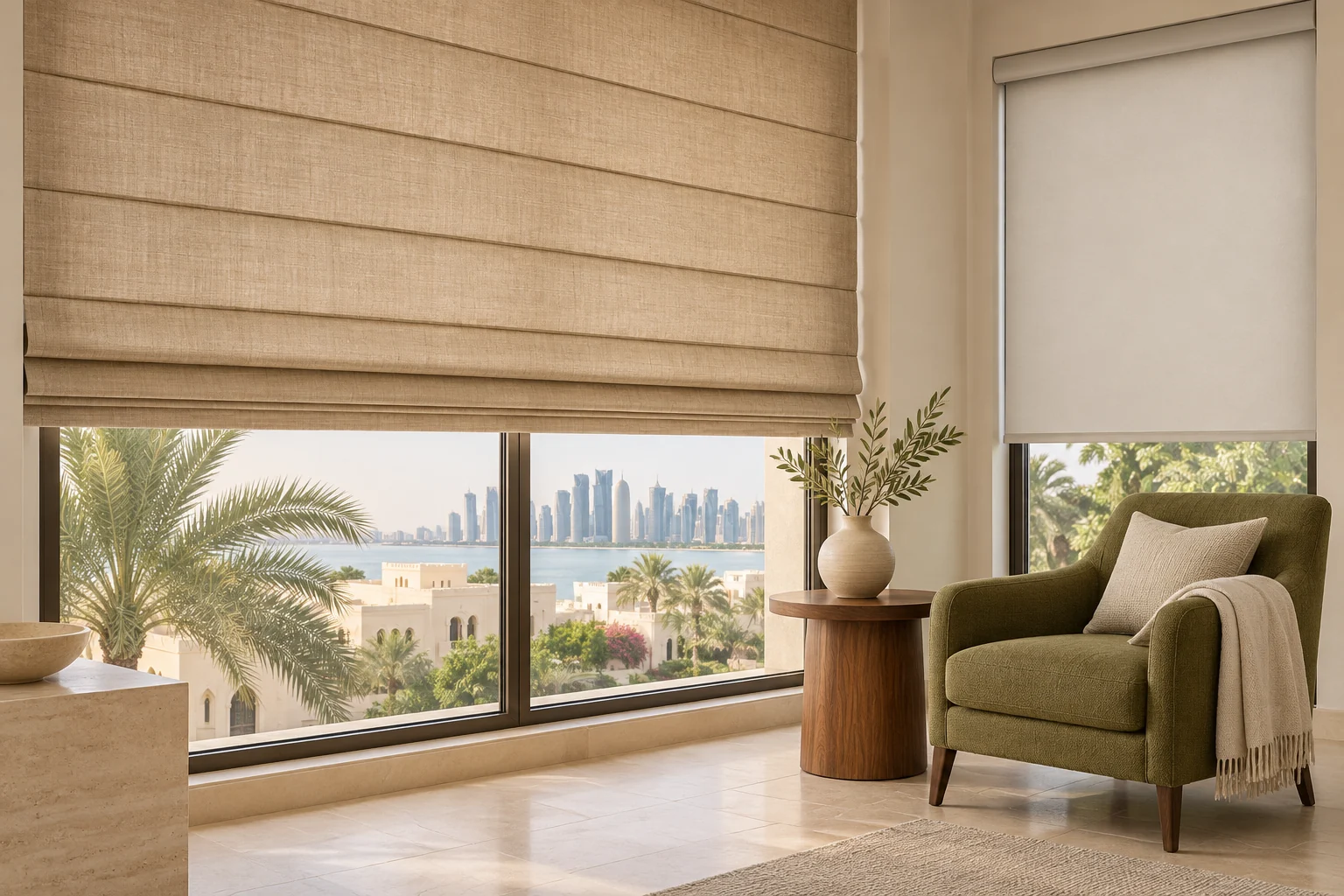
Roman blinds combine the softness of fabric with the structure of a blind. When raised, the fabric forms folds above the window, making headroom an important design detail.
What to consider
01
Allow space for the folds
Check the raised stack height and whether it will cover glass or interfere with an opening window.
02
Compare fabric and lining
Texture, pattern scale and lining affect how folds sit. Compare a sample with the colours and daylight in the room.
03
Plan safe operation
Discuss a suitable operating system, accessible controls and child-safe fitting requirements.
Start with a clear brief.
Share your location, approximate window count and photos. Tell us what you would like to change about the light, privacy or appearance.
Your quotation should confirm materials, dimensions, hardware, fitting scope and the estimated schedule before production.
CHOOSING WITH CONFIDENCE
Plan the raised blind as well as the lowered one.
Where the folds sit
A raised Roman blind still occupies space. Check its stack height against the glass, frame and opening direction.
Pattern placement
Large patterns and repeats can change the appearance of the folds. Ask how the chosen fabric will be arranged across neighbouring windows.
Care and access
Discuss how the fabric and operating system should be maintained and how the blind can be accessed for servicing.
A BETTER BRIEF, A BETTER FIT
Plan the fabric folds and their space.
Look at the blind when raised
A Roman blind still takes up space when it is open. Its raised fabric stack may cover some glass or interfere with an opening window. Confirm the stack location, mounting and control access rather than considering only the appearance of the lowered blind.
Review fabric weight and pattern
Different materials fold differently. A large pattern may look different across several neighbouring blinds, and a heavy construction may need a suitable operating system. Discuss the selected fabric, lining and pattern arrangement together before production dimensions are approved.
Compare the lining with the room’s needs
The face fabric, backing and fitting all affect screening. An opaque lining does not remove every possible edge gap. If a bedroom needs stronger light control, describe the desired result and ask how the selected Roman system and mounting address it.
Plan care and ongoing access
Ask how the fabric should be cleaned and how the blind can be removed or serviced. Consider furniture below the window and safe access to controls. The quotation should identify the selected fabric, lining, operation and fitting rather than simply calling the item a Roman blind.
| Decision | What to compare | Before approving |
|---|---|---|
| Recess fit | Compact appearance | Needs depth and opening clearance |
| Outside fit | Covers beyond the recess | Confirm overlap and raised stack |
| Layered finish | Roman with another treatment | Allow space for both systems |
Questions before you choose
A few practical details to discuss before the final specification.
Can a Roman blind suit a small window?
It may, but the raised stack and opening conditions need checking. A small window can lose a noticeable amount of visible glass if the fabric stack occupies the opening.
Can patterned fabric be used?
It may be suitable depending on the fabric and construction. Discuss the pattern repeat, how it sits in the folds and how neighbouring blinds should line up.
Is a Roman blind the same as a roller blind?
No. A Roman blind forms folds when raised, while a roller winds fabric around a tube. That difference changes the appearance, stack space and maintenance considerations.
LET’S TALK THROUGH YOUR OPTIONS
Tell us about
your windows.
Ask about roman blinds, suitable finishes and a quotation for your space.